
Making Your Own FabLab: CUE-ing Up Momentum
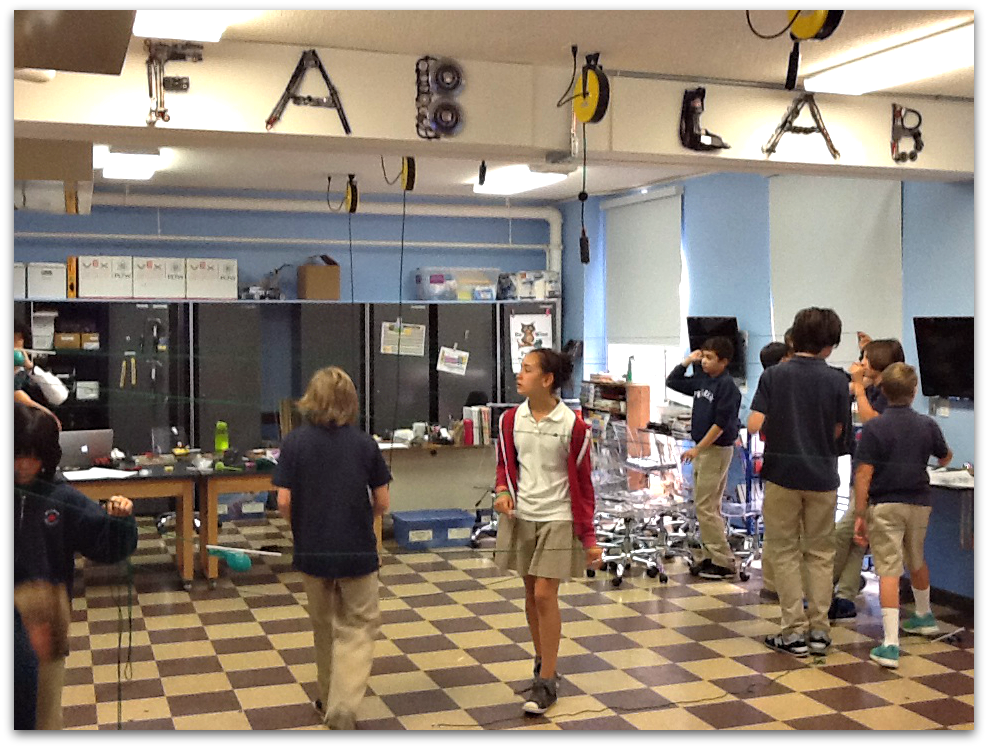
Attending the annual CUE (Computer Using Educators) Conference is always an inspiration to me. I always walk away ready to try new things with my community. This year’s conference was no exception. I connected with a lot of great people and came away refreshed and invigorated.
“My favorite place to be is in a room full of smart people,” is a saying of Dr. Paul Sparks of Pepperdine University and a sentiment with which I have always agreed. CUE is such an experience, except that there were 5,400 smart people in the rooms at the Palm Springs Convention Center. The people who attend CUE are life-long learners interested in sharing their knowledge and ideas, as well as being receptive to the ideas of others. This is the beauty of CUE – the conversations and exchange of take-away ideas are so empowering.
I returned from CUE refreshed and invigorated in my professional life, but facing a big change in my personal life – moving from my home of eight years. As I was packing and moving, I was struck by how difficult it had been to make the decision to move. The idea of sorting, packing, transporting, and storing all of my possessions, not to mention finding a new home and setting up services, was overwhelming. Yet once I took the first step and the process started, my new path began to feel comfortable and to unfold. I had gained momentum.
 I hoped that my presentation at CUE (“Making Your Own FabLab”) would help others take the steps needed to move forward with designing and making their own FabLab. Prior to CUE, I had been fortunate to meet with and speak to other EdTech leaders about the designing and building of FabLabs, and almost unanimously, I heard about the anxiety of being overwhelmed with the process and uncertainty about where to begin. It quickly struck me that this was much the same way I felt about moving. I focused my presentation on how to get these individuals to start the process and take the first step, in order to gain momentum to change their institution.
The first step is, of course, the decision to just begin where you are. Accept where your institution is at and work with what you have. Don’t try to do everything at once, and let go of being the expert in the room. Start simple, but just start!
Where to start? Find a space: big, small, or in between. Perhaps this is a separate room at your institution; perhaps it is your classroom. Be the agent of change, and and know that anything you do to change is a step in the right direction.
 How can I afford to make this 21st century learning space? It’s expensive to buy new furniture — tables, and chairs outfitted with wheels — not to mention the cool things needed for a FabLab, such as a 3D printer. Again, take a “maker attitude” and DIY. We began by looking at our space and at what we had, and seeing how we could recycle. As you will see in the presentation, we took old science lab tables, cut off the legs, and added wheels. Ikea provided inexpensive (but cool looking) chairs and drop down tables. We asked for donations of equipment such as a 3D printer and a CNC machine. We purchased Idea Paint for one wall, and ordered markers and cleaner from Amazon. These simple items gave us the space to begin. We haven’t finished with designing the use of the room, but we started… and that was the important part.
Deciding to begin is often times the hardest part to doing.
So decide to start… and the momentum will come.


Catherine has been a teacher across all grade levels. She holds a B. A and M.A, in History, a Social Science Credential, as well, as an MA in Learning Technology. Besides teaching history/social studies and language arts classes at the middle and high school level she taught in an elementary classroom for twelve years. She has been Media Literacy Specialist and currently teaches middle school technology courses and is the Director of Academic Technology at a private PreK-12 grade school in Los Angeles. She has always been an early adaptor and worked at the forefront to bring technology into the classroom. She piloted a laptop program at the elementary level and integrated technology across the curriculum. She is a Google Certified Teacher and actively presents at conferences. She has worked as an Instructional Designer and Outreach Manager for a leading Gaming Company and helped to design the FabLab for her current school. She also consults and provides professional development on a variety of technology integration topics.
Leave a Reply