
At the 3D Printer World Expo in Burbank
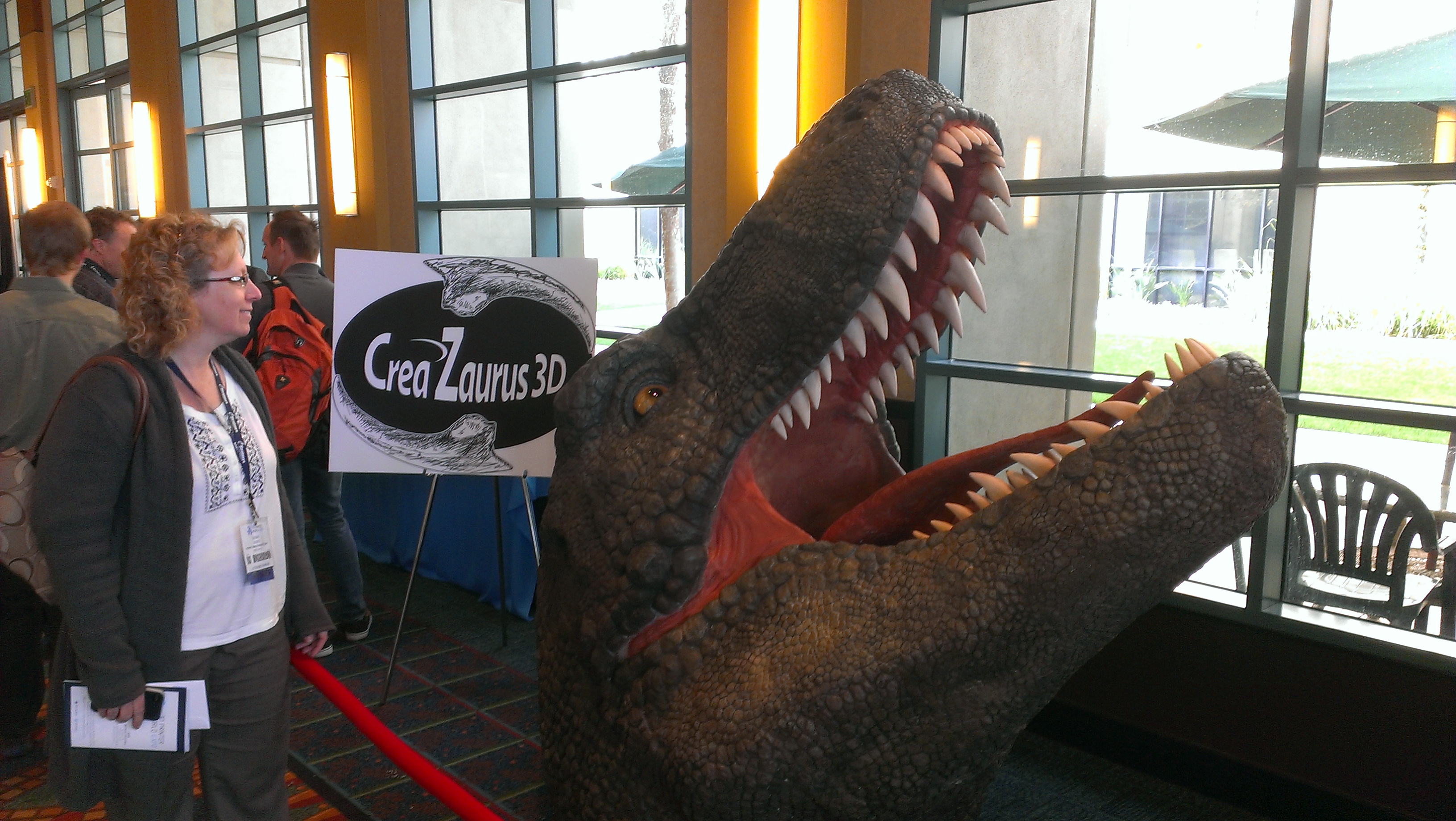
Debby and I had a chance to speak at the 3D Printer World Expo in Burbank, CA, this past week (Jan. 31). We had a blast and quickly got information overload. For those of you that couldn’t go, we thought we’d share a few highlights.
As we entered the conference center we saw some awesome 3D printed scupltures and other 3D art.


Conference Keynote
After admiring the 3D art in the entryway, we made our way to the keynote address featuring Cydni Tetro (founder and CEO of 3DPlusMe), Brent Heyning (founder of ToyShoppe Systems), Jesse McGatha (senior program manager for Microsoft), Mark Setrakian (producer, puppeteer, and robot creator), and Mick Ebeling (founder and CEO of Not Impossible Labs). The introduction video for the session was one of those videos that rivets you to your seat, takes you on an adventure, and then asks you to join a cause. You can judge for yourself by clicking the video below.
After the video, Cydni blew through a hurricane of 3D printing information. She discussed the financial implications of the technology, the adoption curve, and a host of other aspects of the industry as a whole. However, the two most enlightening things she highlighted were very eye opening. First, she asked the audience of 3D printing enthusiasts how many owned or used a 3D printer on a daily basis. I was shocked when only 5-10% of the attendees raised their hands. That means of the more than 3500 people who attended the conference from over 20 countries, only about 250 of them had or used a 3D printer on a regular basis! This fact tells me that 3D printing is still very much in its infancy, and more than ever, I am positive that the mission of WRI3D.com to put 3D printers in classrooms is critical to brining this technology intelligently to our culture. The second point that really stuck with me was that the number one issue in the industry as a whole is the lack of digital content. In the 3D printing in education space we are very aware of this deficit, but it surprised me that industry as a whole is limited at the moment by the same issues that we at WRI3D.com have identified. One of the highlights of the keynote was when Brian Setrakian pulled forth from a box the Giant, chain-bound hand of Mr. Wink (from HellBoy fame). The hand was the genuine working prop from the film complete with servo driven fingers and motor-retractable hand. The audience loved it. No wonder the hall was standing room only during the keynote.

Educational Panels at the Conference
This was the highlight of the conference for us. Debby and I love to share what we know and to help teachers, administrators, and community partners bring Maker Education into local classrooms. Debby was on a panel discussion in the morning that addressed how to attract and write grants for your 3D printer classroom initiative. She shared the stage with Joe Scott who works with Afinia (a maker of consumer 3D printers) and manages their marketing and spends a fair amount of time in community outreach. Rather than recap here what they discussed, you can read their notes and download their slides here.


In the afternoon, Steve joined David Thornburg of the Thornburg Center, Christine Mytko who teaches in the Bay area, and Clark Barnett who teaches in the Conejo Valley Unified School District here in southern California. The panel discussion was moderated by John Westrum from Afinia. The questions ranged from “How do teachers address the Common Core and Next Generation Science Standards with 3D printing in the classroom?” to “What are some of the practical challenges of introducing 3D printers into a classroom?” Each panelist brought their own unique experience and perspective to the panel for a very lively discussion.
Christine Mytko has been using 3D printers in her classroom along with visiting their local particle accelerator to enhance student understanding of both the scientific process as well as the scale of really small things. Her students begin by placing common objects into the beam path and getting nano-scale (one billionth the size of you and me) images of things like egg shells, candy surfaces (Mentos(R) in particular), and other fun objects. These nanoscopic images (nanoscopic is 1000 times smaller than microscopic) of surfaces are then converted to 3D files and Christine prints large scale versions on a 3D printer in her classroom! Talk about relevant science!
Clark Barnett has been using 3D printers in his classroom to create ecosystems. His students begin by considering the ecosystem of their classroom with books, food left in corners from student snacks, and even the students themselves. Then they invent new bugs with appropriate insect morphology. Their classroom has now discovered several new species which they have on display in cases like these:


The students have to think like entomologists to create the proper background on their creatures, and after a little while the students began to have some classroom species as predators of others. In fact, a couple of students even created stop motion video with their bugs. The creativity expressed in this particular project was astounding!
Dr. David Thornburg has been making for as long as he can remember according to a recent interview we had with him. At the Thornburg Center, they explore emerging technologies and help educators create effective methods for incorporating these new technologies into the classroom. Of course, one of the exciting new technologies being explored at the moment is 3D printing. Dr. Thornburg shared a wealth of information and stories to illustrate the exciting ways in which 3D printing can be used as a catalyst to encourage deeper learning and exploratory behavior. Exploration appears to be at the very center of human learning, and Dr. Thornburg loves to explore. You can learn more about him at the Thornburg Center’s website, the interview we had with him, or at the Thornburg Center for Space Exploration.

The Exhibit Hall at 3D Printer World Expo
Later in the afternoon, Debby and I had a chance to wander around the exhibit hall. Many of the faces and personalities in the 3D printer and design market were at the show, including Afinia, FormLabs, AirWolf 3D, Stratasys, ZBrush, and many more. In addition there was another display of fantastic 3D art. My favorites were those by Cosmo Wenman. Here are some of the pieces.


This last piece with the bronzed horse head has impressed me since the first time I saw in at the Consumer Electronics Show (CES) in 2013. Cosmo is working on a system and a formula to make bronzing and creating a metallic oxidized patina accessible to everyday artists. I very much admire his work.
We had a fantastic time at the 3D Printer World Expo in Burbank this year (2014), and we look forward to going again next year.


Muahahahahaaaaaaaaaaaaaa!!!!!!!!!! Ok, now that I have that out... I can get to work. For as long as I can remember, I have been making things. This habit used to be called "Inventing" but has lately been repurposed by the Maker community with the term "Maker". While there are some subtle differences between Inventing and Making, I have discovered my passion for both by inspiring a new generation of Makers. In this quest to spark creative thinking and problem solving through practical and exciting projects, I draw on my background in biomedical research, high energy fiber laser development, and 15 years of building laboratory devices. As an experimental physicist with a PhD from Case Western Reserve University, I have seen research and development from many angles and am now bringing that experience to middle school and high school students who want to make everything from catapults to cybernetic augmentations. Through the medium of Making and Inventing, students are transformed from passive observers of education to active learners. This powerful shift fosters deep insights, creative expression, collaborative thinking and a host of other skills that are difficult to learn in traditional settings. Along with my wife Debby, an accomplished constructivist educator, I am on a quest to transform education and am looking for like-minded collaborators to bring hands-on learning to future generations.
Leave a Reply